Somewhere in the east wing of the palace at Knossos there is a small room with a drain in the floor. It is not much to look at. Tourists walk past it on the way to the frescoes. But that drain is connected to a system of fired clay pipes and stone channels that was engineered, deliberately and cleverly, around 1800 BC, and it is one of the strangest things on the site.
Not because it is old. Because of how long it took anyone to do it again.

What is actually down there
Three things survive at Knossos, and all three can be seen or are held in the museum at Heraklion.
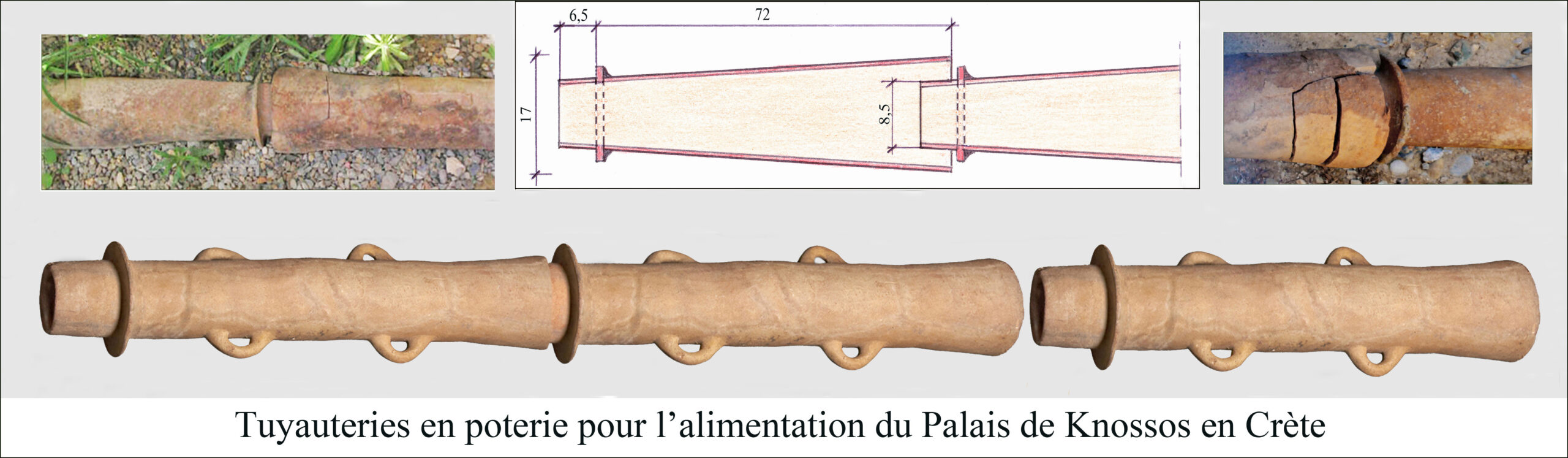
Terracotta pipes. Sections of fired clay, each about seventy centimetres long, tapered so that one end slots into the next. They were sealed at the joints and laid in runs beneath the floors.
Stone channels. Open conduits cut into the fabric of the building, carrying rainwater down from the roofs and the light wells. At the corners they do something unexpected, which we will come back to.
A room with a drain. In the area Evans named the Queen’s Megaron there is a small compartment connected to the drainage system, generally interpreted as a latrine, and generally described as flushable with a jug of poured water.
The pipe that was built to clean itself
The interesting part is not that the pipes exist. Plenty of ancient cultures moved water. The interesting part is the shape.
Each pipe section is wider at one end than the other. Water entering the wide end is squeezed into the narrow end, which means it speeds up. Faster water carries sediment along instead of letting it settle. In other words, the pipe is designed so that its own flow scours it clean.
That is not an accident of manufacture. It is the same principle a modern sanitary engineer applies when sizing a sewer for self cleansing velocity, and somebody worked it out on Crete in the Bronze Age.
The stone channels show the same kind of thinking. Where a channel turns a corner or drops down a level, the Minoan builders cut the bends as curves rather than right angles, which slows the water and keeps it from leaping out of the channel on the turn. Anyone who has watched a gutter overflow at a corner in heavy rain will recognise the problem they were solving.
Then and now
Rome’s great sewer, the Cloaca Maxima, is usually dated to around 600 BC. That is more than a thousand years after the Knossos system was in the ground.
Closer to home, London did not build a modern sewer network until the 1860s, and it took the Great Stink of 1858, when the smell of the Thames drove Parliament out of its own building, to force the decision. On this one specific problem, roughly thirty five centuries passed between a good solution and the next good solution.
Where the story gets oversold
Here is where a lot of articles about Minoan plumbing stop, and where this one should not.
The word “first” is doing heavy lifting. Drainage and water management existed in Mesopotamia and in the Indus Valley cities of Mohenjo daro and Harappa, some of it earlier, some of it comparable. Knossos is remarkable, but “the first flushing toilet in the world” is a claim that travels much better than it survives.
Arthur Evans wanted this story to be true. Evans excavated Knossos from 1900 and spent decades presenting the Minoans as a civilisation of refinement and comfort, in explicit contrast to what he saw as the cruder mainland Greeks. The plumbing fitted that argument perfectly, and his interpretation of certain rooms as bathrooms and lavatories has been questioned since. Some of the rooms he identified may have served ritual rather than sanitary purposes.
The system may not have worked the way we assume. Whether Knossos had a piped clean water supply, or whether the pipes carried rainwater only, is not settled. Separating storm water from waste is a modern instinct, and reading it back into the Bronze Age is exactly the kind of mistake this site tries not to make.
None of that undoes the pipes. The pipes are real, the taper is real, and the engineering thought behind them is real. What is uncertain is the story we hang on them.
The Minoans did not invent the toilet. They solved a drainage problem well, unusually early, and then the knowledge died with them.
Why it matters
There is a comfortable assumption underneath most popular history, which is that technology accumulates. Somebody figures something out, it gets written down, everyone builds on it.
Knossos is a small argument against that. A group of people worked out how to move dirty water out of a large building without it backing up or stinking, they built it, they used it for centuries, and then the palace fell and the technique went with it. Nobody in Europe did it as well again for a very long time.
The pipes are not impressive because they are ancient. They are impressive because they are a reminder that knowledge can be lost, and usually is.
Read next
- [Knossos explained: what every part of the palace actually did]
- [Arthur Evans at Knossos: restoration or invention?]
- [Nobody bothered to build a wall]
Sources
- Arthur Evans, The Palace of Minos at Knossos, volume 1, 1921
- J.D.S. Pendlebury, A Handbook to the Palace of Minos at Knossos, 1933
- Heraklion Archaeological Museum, Minoan pottery and architecture collections
- [Créditos “Photo: Le plombier du désert, CC BY-SA 4.0, via Wikimedia Commons”.]
